From Match Data to Digital Decisions: How Sports Information Is Reshaping Modern Toto Platforms
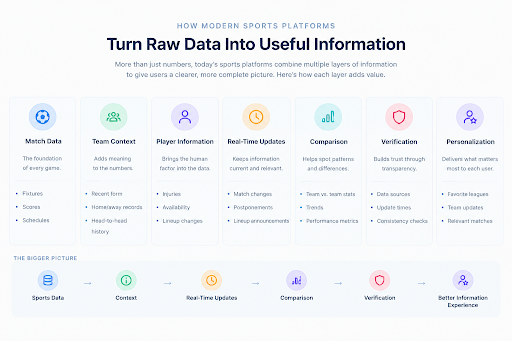
Sports platforms are entering an information-heavy era. A modern match page is no longer just a fixture listing. These elements can be integrated into a single information system. Why is this development important? Digital sports services are assessed on how well they organise information, not on how much they are publishing. It is most clearly seen in the way platforms deal with changing match information. Users no longer just want the number placed somewhere on the page. They also want an explanation of what this number means, its source, and how old it is.
Thus, a Toto/betting site (토토사이트) can be viewed not simply as a list of events, but as an information product built around multiple data sources. The quality and relevance of this data can greatly affect user experience.
The Data Layer Behind Every Match
A sports information experience begins before a reader opens an individual match page. Beneath the surface, there is an ever-evolving pool of data that needs to be acquired, analyzed, monitored, and presented effectively.
Useful data can include information about competitors, past performance, past meetings, players’ availability, home/away records, fixture congestion, etc.
The trick is not to collect more numbers. When every statistic gets equal attention, important facts can disappear in the noise. Strong platforms distinguish essential information from deeper context.
Context Gives Sports Data Meaning
A fixture alone tells you little. Context gives the fixture meaning.
Recent results may appear impressive until the strength of previous opponents is considered. A winning streak can also be analyzed against the background of injuries or alterations to the starting line-up. Sports data is thus becoming increasingly contextual rather than simply numerical.
Connected platforms can create an information trail covering form, history, personnel, competition, and schedule conditions. This gives readers a broader picture.
Real-Time Information Changes Expectations
Sports information is highly time-sensitive. A press release on players, an injury report, rescheduling of a match, or a change in the venue may very quickly render previously released information obsolete.
This sets up a crucial technical requirement: Information is not just supposed to be there, but current.
Reliable platforms need update systems capable of handling frequent changes while maintaining consistency across pages. When the same fixture appears in several sections, contradictory details in one location can weaken confidence in the entire service.
Trust Depends on Verifiable Information
Sports data creates another important issue: credibility. A platform can use sophisticated dashboards, but unexplained statistics or unclear update times may weaken trust.
Users are more interested in transparency policies, clear sources of information, consistent records, and definitions. This is where 먹튀검증 can become part of the wider discussion of digital trust. Verification is most helpful when it revolves around evidence, consistency, and standards that are easy to explain.
Trust occurs when information remains clear, consistent, and traceable. This is also why the second stage of evaluating a Toto/betting site (토토사이트) should extend beyond visual polish and examine the quality and consistency of its information practices.
Comparison Is Becoming a Core Information Tool
Another development is the move from individual statistics toward comparison. Instead of presenting two teams separately, modern platforms can place selected metrics side by side.
Useful comparison categories can include:
- Recent form over a defined number of matches
• Scoring and defensive records
• Home versus away performance
• Head-to-head history
• Squad availability
It will help make the pattern clearer. There will still be uncertainty in sports, and there will always be variables that cannot be statistically determined in a live situation. Responsible information design should help readers understand evidence rather than present numbers as guaranteed outcomes.
Personalisation Without Information Overload
The next stage of sports platforms may involve personalised information feeds. A reader interested in a particular league could receive relevant fixtures, team updates, recent form, and statistical developments without navigating unrelated competitions.
However, personalisation needs restraint. Too many alerts or data panels can become noise.
Effective personalisation should reduce effort. The best systems help readers reach relevant information faster while preserving access to the wider dataset.
Data Quality Is Becoming a Competitive Signal
As sports data becomes widely available, simply publishing more statistics will not create meaningful differentiation. The advantage comes from accuracy, consistency, update speed, and useful organisation.
Five principles are becoming especially important:
- Accuracy over volume
• Context over isolated statistics
• Timeliness over static information
• Comparison over fragmented pages
• Transparency over unsupported claims
These principles turn sports information into a product rather than a collection of numbers.
The Bigger Shift in Sports Information
The transformation of digital sports platforms reflects a wider change in how information is collected, organized, updated, and understood.
Platforms that simplify complex information, provide consistent updates, and present it responsibly can help build user trust. In a crowded online space, the challenge is not necessarily about having the most information available but the right information.