
Picture this: you’ve spent half an hour studying a football match. The home team has won four of its last five games, its leading striker is in excellent form, and everything seems to point towards another victory.
Then, shortly before kick-off, the starting lineups arrive. The striker isn’t playing. Two regular defenders are missing, and the manager has switched formations.
Suddenly, that confident prediction doesn’t look quite so convincing.
This is where a proper football betting strategy becomes useful. Instead of relying on reputation, winning streaks or somebody else’s tips, you follow a repeatable process that helps you understand what you know, what you’re assuming and what might change before the first whistle.
Reliable football information is an essential part of that process. For Premier League matches, MatchXI.com provides a useful starting point for checking fixtures, recent results, predicted lineups, official team sheets and player-availability updates. These details help build a more complete picture of the match without pretending that a lineup prediction guarantees a particular result.
So, what should you actually check before making a football prediction? Here are six practical steps.
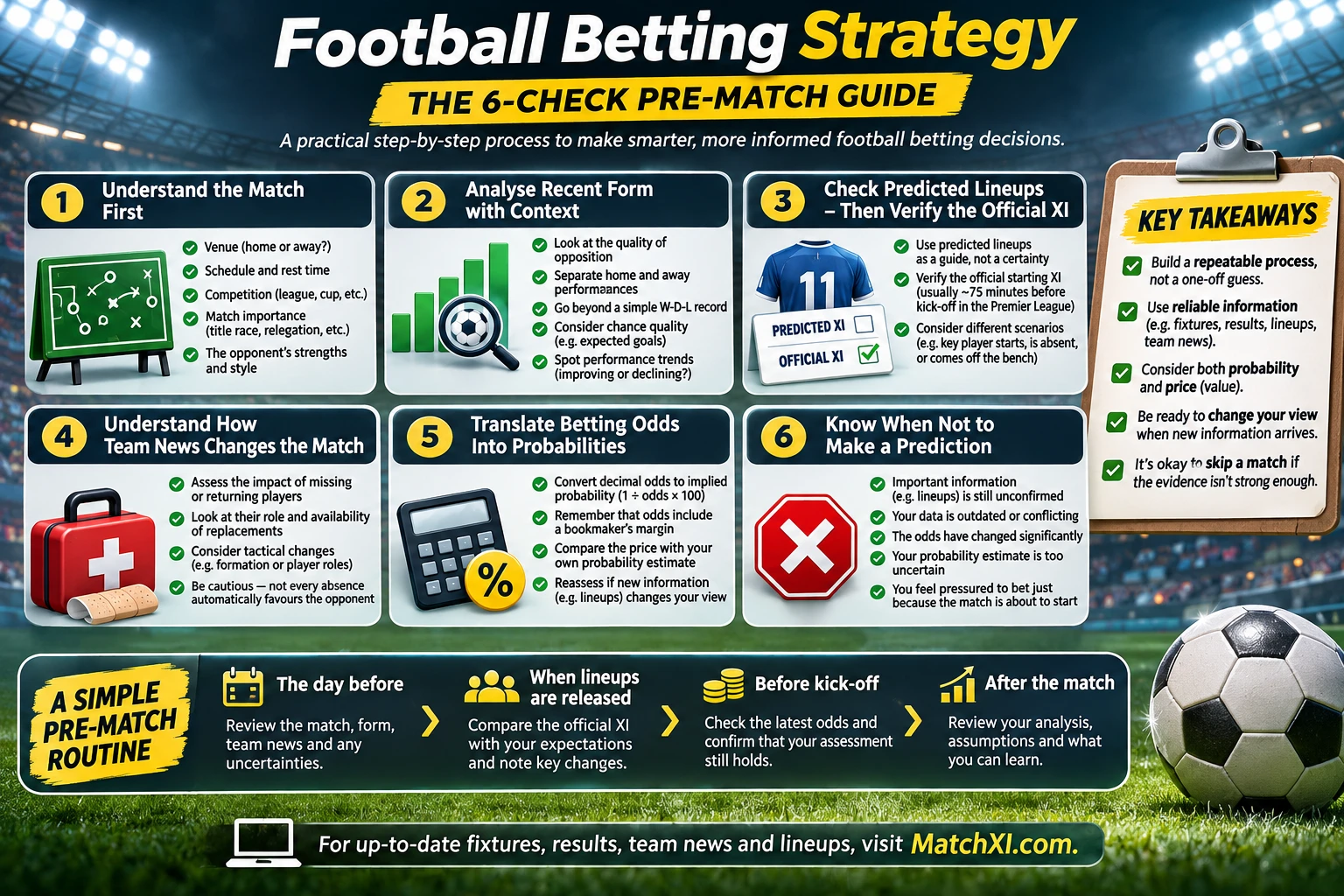
1. Understand the Match Before Looking at the Odds
One of the most common mistakes in football analysis is starting with the betting market instead of the match itself.
You see a big club priced as the favourite. You remember its impressive performance last weekend. You immediately assume another win is likely.
But football doesn’t work that way.
Before studying prices, ask yourself a few basic questions:
- Where is the match being played? Some teams perform very differently at home and away.
- How much rest has each team had? A side playing its third match in seven days faces different challenges from one that has enjoyed a full week of preparation.
- What is the competition? League games, domestic cups and continental competitions can produce very different selection decisions.
- How important is the fixture? The context of a title race, relegation battle or two-legged knockout tie may influence a manager’s approach.
- Who is the opponent? A team that has beaten several struggling sides may face a completely different test against an organised defensive opponent.
None of these factors predicts the outcome on its own. Their value comes from establishing the conditions in which the match will be played.
A team may be stronger on paper yet face a difficult tactical matchup. Conversely, an underdog with a disciplined defensive structure may be more competitive than its league position suggests.
The objective is not to find a reason to support your favourite team. It is to understand the football match you are analysing.
2. Read Recent Form Without Falling for Winning Streaks
Recent results matter, but they can be misleading when examined without context.
Imagine two teams that have each collected 12 points from their previous five matches.
At first glance, their form looks almost identical. But consider how those points were earned.
Team A defeated three relegation candidates, scraped a narrow victory against a mid-table opponent and lost comfortably to a top-four side.
Team B defeated two strong opponents, drew away against a title contender and played consistently well despite one defeat.
The identical points totals conceal very different performances.
That’s why a useful football betting strategy should look beyond the familiar W-D-L sequence.
Examine the quality of opposition
Ask whether recent opponents were strong, weak, in good form or dealing with their own selection problems.
A winning streak against lower-ranked teams is not automatically evidence that the same performances will continue against stronger opposition.
Separate home and away performances
A team might have an excellent overall record but struggle to create chances away from home.
Similarly, a club with modest league form could be extremely competitive at its own stadium.
Home and away splits can reveal patterns hidden inside combined statistics.
Look beyond goals scored
Goals matter, but the final score doesn’t explain everything.
If suitable data is available, examine:
- Chances created and conceded.
- Shot quality, including expected goals (xG).
- Defensive consistency.
- The frequency of dangerous attacking opportunities.
- Whether performances are improving or deteriorating.
Expected goals can provide useful context about chance quality, but xG is not a guaranteed forecast of future scoring.
And remember: five matches are a small sample. Treat short-term patterns as clues rather than statistical certainty.
3. Check Predicted Lineups — Then Verify the Official XI
This is arguably the most important timing-related step in pre-match football analysis.
A team can look excellent statistically, but those numbers describe players who were available for previous matches.
If several key players are unavailable for the next fixture, the situation may be different.
However, there’s an important distinction between a predicted lineup and a confirmed lineup.
A predicted lineup is an informed estimate of who might start. It can incorporate previous selections, player availability and tactical expectations, but it remains a forecast.
An official lineup confirms the players selected to start that particular match.
In the Premier League, official starting lineups are normally announced around 75 minutes before kick-off. Timing varies across competitions.
Before the official announcement, consider different selection scenarios rather than treating one predicted XI as certain.
For example, suppose a team’s regular centre-forward has been doubtful throughout the week.
Your analysis should consider at least two possibilities:
- The striker starts: the team’s usual attacking structure may remain intact.
- The striker is absent: the manager may select a different forward, change the formation or redistribute attacking responsibilities.
There is also a third possibility: the striker appears among the substitutes and may play only part of the match.
Each scenario carries different implications, and none guarantees a result.
The smartest move is often to wait for reliable information rather than rush towards an early conclusion.
A useful rule: Don’t ask only, “Who will win?” Ask, “What information would make me change my prediction?”
4. Understand How Team News Changes the Match
Not every missing player has the same impact.
An absent striker attracts attention, but the loss of an important defensive midfielder might have a greater effect on how a particular team performs.
Similarly, a change in goalkeeper may matter differently depending on the substitute’s experience and the defence in front of them.
Instead of treating every injury as a reason to oppose a team, examine the role of the missing player and the available replacements.
A practical team-news checklist
| New information | Possible implication | What to investigate |
|---|---|---|
| Leading striker unavailable | Changes in attacking movement or finishing options | Who replaces the striker, and how does the team usually play without them? |
| Regular goalkeeper absent | Potential changes in defensive organisation | How experienced is the replacement, and is the usual defensive unit intact? |
| Two starting defenders rotated | Different defensive partnerships | Have the replacements played together before? |
| Creative midfielder missing | Changes in chance creation and attacking combinations | Who takes responsibility for progressing the ball and creating chances? |
| Several players rested after a midweek fixture | Possible changes in cohesion or physical intensity | Which players completed heavy minutes, and who is available to replace them? |
| Official XI matches the predicted lineup | Less new selection information than expected | Has the market already accounted for this team selection? |
The final column is particularly important.
It prevents a common mistake: interpreting team news as an automatic betting signal.
For example, a star winger missing from the starting XI does not necessarily make the opposing team more likely to win. The replacement could be a better tactical fit for the specific opponent.
Likewise, a strong lineup does not automatically make the favourite a good selection at any price.
Football analysis requires understanding the relationship between individual players, team structure and opposition.
5. Translate Betting Odds Into Probabilities
Even a well-researched football prediction can be a poor betting decision if the available price does not justify the risk.
Consider a simple example.
A bookmaker offers decimal odds of 2.20 on a home victory.
The raw implied probability is:
Implied probability = (1 ÷ decimal odds) × 100
Therefore:
(1 ÷ 2.20) × 100 = 45.45%
The quoted price corresponds to an implied probability of approximately 45.5%.
However, bookmaker odds generally include a margin. You cannot assume that the raw percentage represents the true probability of the outcome.
To understand the margin in a standard three-way market, you would need to examine the home win, draw and away win prices together.
Why the price matters
Imagine that your own carefully developed model estimates the home team’s chance of winning at 48%.
At odds of 2.20, the hypothetical expected return per unit staked would be:
Expected value = (estimated probability × decimal odds) − 1
(0.48 × 2.20) − 1 = +0.056
That corresponds to a theoretical expected return of +5.6% per unit staked.
Now imagine the official lineup reveals an unexpected absence, and your revised estimate drops to 42%.
At the same unchanged price:
(0.42 × 2.20) − 1 = −0.076
The theoretical expected return becomes −7.6%.
These probabilities are invented solely to explain the calculation. They are not estimates for a real fixture, and producing reliable probabilities is considerably harder than applying the formula.
Nevertheless, the example demonstrates an essential principle:
A potentially attractive price can become unattractive when the information behind your estimate changes.
And the opposite is possible too.
If a bookmaker adjusts its odds after team news, you need to evaluate the new price rather than rely on the earlier one.
This is the foundation of value-based football analysis. It isn’t about choosing the most likely winner. It’s about judging whether your probability estimate supports the price being offered.
Crucially, an apparent positive expected value is only as reliable as the underlying probability estimate.
6. Know When Not to Make a Prediction
Every football betting strategy needs a rule for situations in which the evidence is insufficient.
Suppose you’re analysing a cup match between two teams that rarely play each other.
The home side has been rotating heavily, the visiting team has several players listed as doubtful, and there is no reliable information about the likely starting elevens.
You can still study historical form, but important uncertainty remains.
In that situation, forcing a confident prediction doesn’t make your analysis more sophisticated.
It simply makes it less honest.
Reasons to reconsider or skip a selection
- A key assumption depends on an unconfirmed lineup.
- Your information is outdated or contradictory.
- The available odds have changed substantially since your original assessment.
- Your probability estimate is too uncertain to distinguish a potential advantage from normal estimation error.
- You cannot explain why you believe the available price is attractive.
- You feel pressure to make a selection simply because a match is about to start.
Skipping a match is a legitimate outcome of good research.
In fact, knowing when the evidence is insufficient is one of the most useful skills in football analysis.
It is also important to separate analysis from financial behaviour. No strategy can eliminate the risk of losing money. Never bet money you cannot afford to lose, avoid chasing losses, and follow the legal gambling age and rules in your jurisdiction.
A Simple Pre-Match Routine You Can Actually Follow
The six checks above become much more useful when you apply them consistently.
Here’s a straightforward routine for an upcoming football fixture.
The day before the match
Start with the football, not the bookmaker.
Review the fixture, recent results, quality of opposition, home and away performances, schedule congestion and available team news.
Write down your initial assessment, including anything that remains uncertain.
Don’t treat a predicted starting lineup as confirmation.
When official lineups are released
Compare the actual starters with your earlier expectations.
Look for meaningful differences:
- Is a key attacking player missing?
- Has the manager changed formation?
- Are important defensive partnerships intact?
- Is the goalkeeper the expected starter?
- Has a player returned earlier than anticipated?
Focus on the changes that could affect the specific match and market you are evaluating.
For example, information that matters for an Over/Under goals assessment may not have the same significance for a 1X2 home-win prediction.
Before kick-off
Review the latest available prices.
Ask whether your original assumptions still hold and whether any new information has already influenced the market.
If your assessment changes, update it rather than defending the original opinion.
If the evidence does not support a clear conclusion, leave the match alone.
After the final whistle
Keep a short record of your analysis.
Note the information available before kick-off, your assumptions, the market and price considered, and whether you made a selection or passed.
Later, compare the process with what actually happened.
Did the predicted lineup prove accurate? Did a tactical change matter? Did you overreact to a single recent result?
A winning outcome doesn’t automatically mean the reasoning was good, just as a losing outcome doesn’t prove the analysis was poor.
Over time, reviewing your assumptions can be more educational than simply counting correct predictions.
Three Common Football Betting Mistakes
Even experienced football followers can fall into predictable traps.
Mistake 1: Following a winning streak without context
Five straight victories sound impressive, but the opponents, home and away split, performance quality and available players all matter.
A streak is a starting point for investigation, not a complete prediction.
Mistake 2: Assuming important team news guarantees a result
An unexpected absence can influence a match, but the effect depends on the replacement, the tactical setup and the opponent.
A missing player is information to evaluate, not a mathematical instruction to back the other team.
Mistake 3: Confusing confidence with value
You can be highly confident that a favourite will win and still find the available price unattractive.
Probability and price must be considered together.
Similarly, a selection with an apparently favourable expected value can lose. Positive expected value is not a promise of profit, especially when the probability estimate itself is uncertain.
Final Thoughts: Build a Process, Not a Collection of Lucky Guesses
Football will always contain surprises.
A goalkeeper can produce an extraordinary performance. A substitute can change the match. A dominant team can concede from its opponent’s only meaningful attacking opportunity.
No amount of pre-match research removes that uncertainty.
But a structured football betting strategy can help you avoid common analytical mistakes.
Study the match context. Evaluate recent performances. Check the latest team news. Distinguish predicted lineups from official team sheets. Understand what the odds imply. And, perhaps most importantly, be willing to change your opinion when the evidence changes.
The goal isn’t to predict every result correctly.
It’s to make your reasoning more transparent, repeatable and grounded in reliable information — and to recognise when the most sensible decision is not to make a prediction at all.