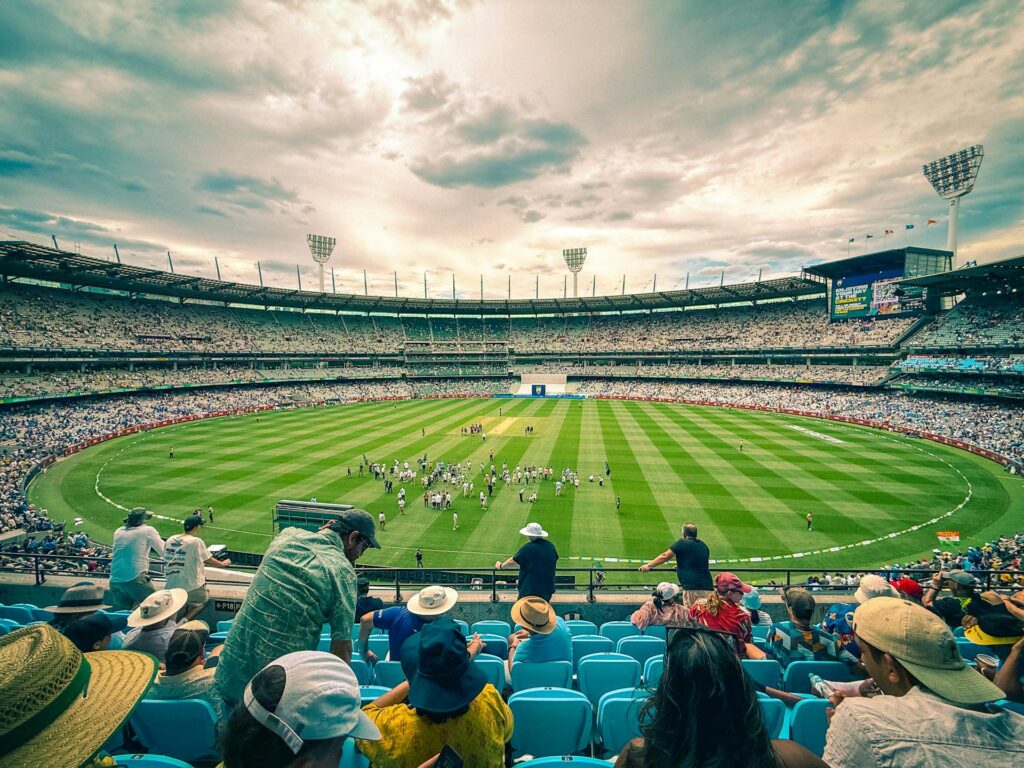
On a game night in New York, the contest does not begin at the turnstile. It starts three, six, sometimes ten blocks earlier: at the subway exit, at the avenue corner where fans stop to film, at the retail frontage where foot traffic slows just enough for a brand to register. That is why sports marketers do not treat a commercial building wrap as decoration. They treat it as territorial control. In a city where the subway logged more than one billion trips in 2025 and set post-pandemic daily records above 4.6 million riders, the block outside the venue can matter almost as much as the venue itself.
That is the real meaning behind building wrap ads sport. The phrase is awkward. The strategy is not. Nike, Adidas, sportsbook operators, event promoters, and arena-district advertisers all work from the same operating logic: dominate the path fans actually travel, not the one shown on a seating map. Out-of-home advertising keeps growing because that logic still works. OOH revenue in the US hit a record $9.46 billion in 2025, while OAAA says 74% of mobile-device users took some action after recent digital out-of-home exposure, including 44% who searched for the advertiser and 30% who went to social media.
For a New York business owner, that matters for two reasons. First, the sports world has already tested the playbook at scale. Second, the same logic can be adapted for a restaurant, clinic, retailer, or multi-location chain trying to own a corridor around an arena, fan zone, or transit hub. A company like Easy Way Install is not competing with Nike’s media budget. It is competing on whether it can execute the same territorial discipline for a client that needs results, compliance, and speed.
The blocks that matter more than the stadium
Many companies still buy visibility the way amateurs buy real estate: they chase the most famous address. Professionals buy the route. They map where the crowd emerges, pauses, queues, films, and spends.
That is why transit adjacency matters. Barclays Center is not just an arena; it sits beside one of the largest transit hubs in New York. For sports marketing, that changes the math. The winning block is often not the closest one to the front door but the one with the heaviest fan spill, best camera angle, and strongest link to retail or hospitality.
The same principle is already visible in event planning for 2026. The New York/New Jersey World Cup host committee has designated major fan destinations in Queens and Midtown Manhattan, including the USTA Billie Jean King National Tennis Center and Rockefeller Center. Sports Business Journal separately noted MLS interest in the USTA fan-zone footprint because adjacency creates value before and after the match itself. That is territorial marketing in plain form: own the route, own the memory, own the spend nearby.
Outside New York, arena districts say the quiet part out loud. Columbus’s Arena District markets wallscapes, billboard takeovers, plaza activations, and garage wraps as a unified neighborhood media system reaching more than six million people a year. That is not an accident of inventory. It is a map of how sports districts function commercially.
Why scale works when smaller signage does not
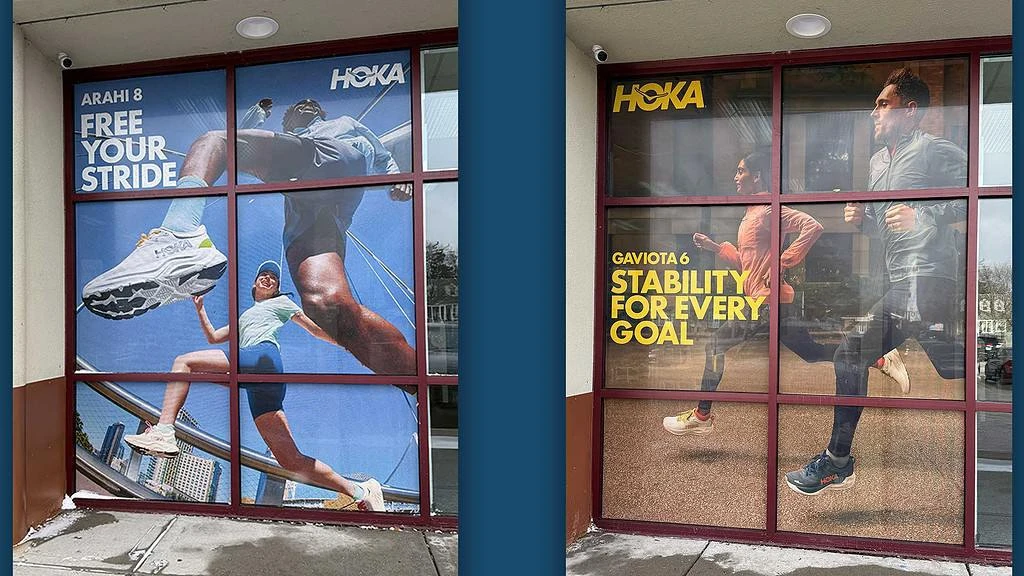
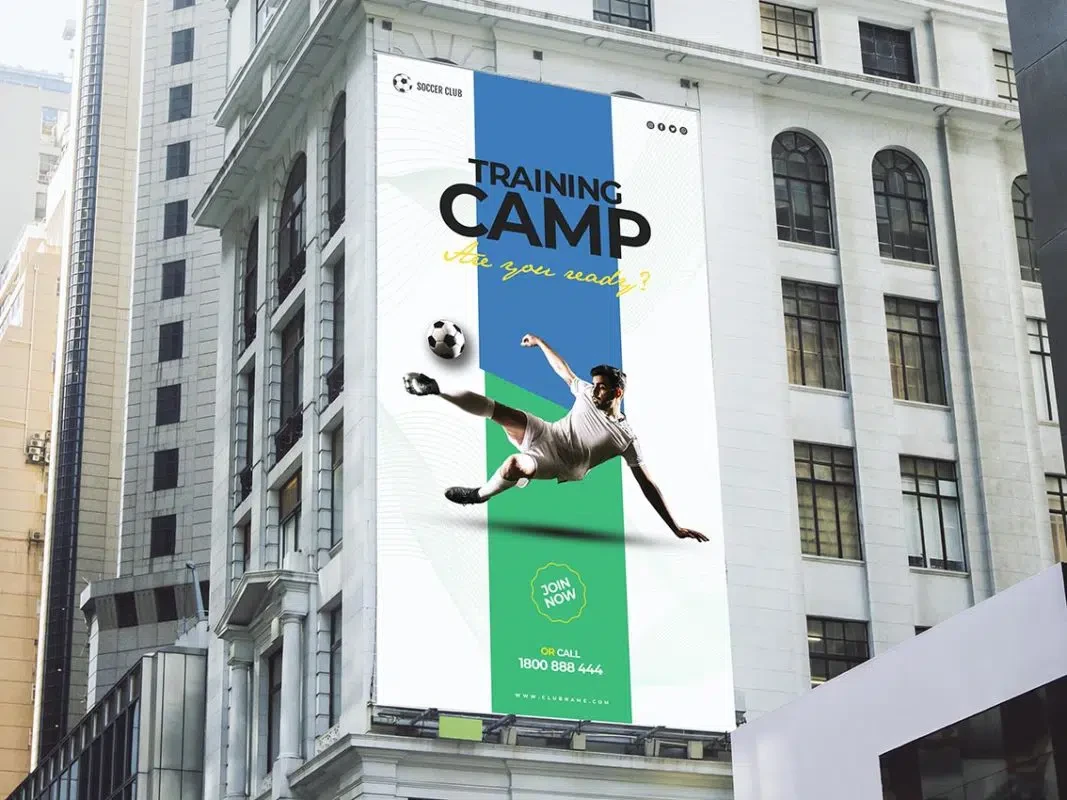
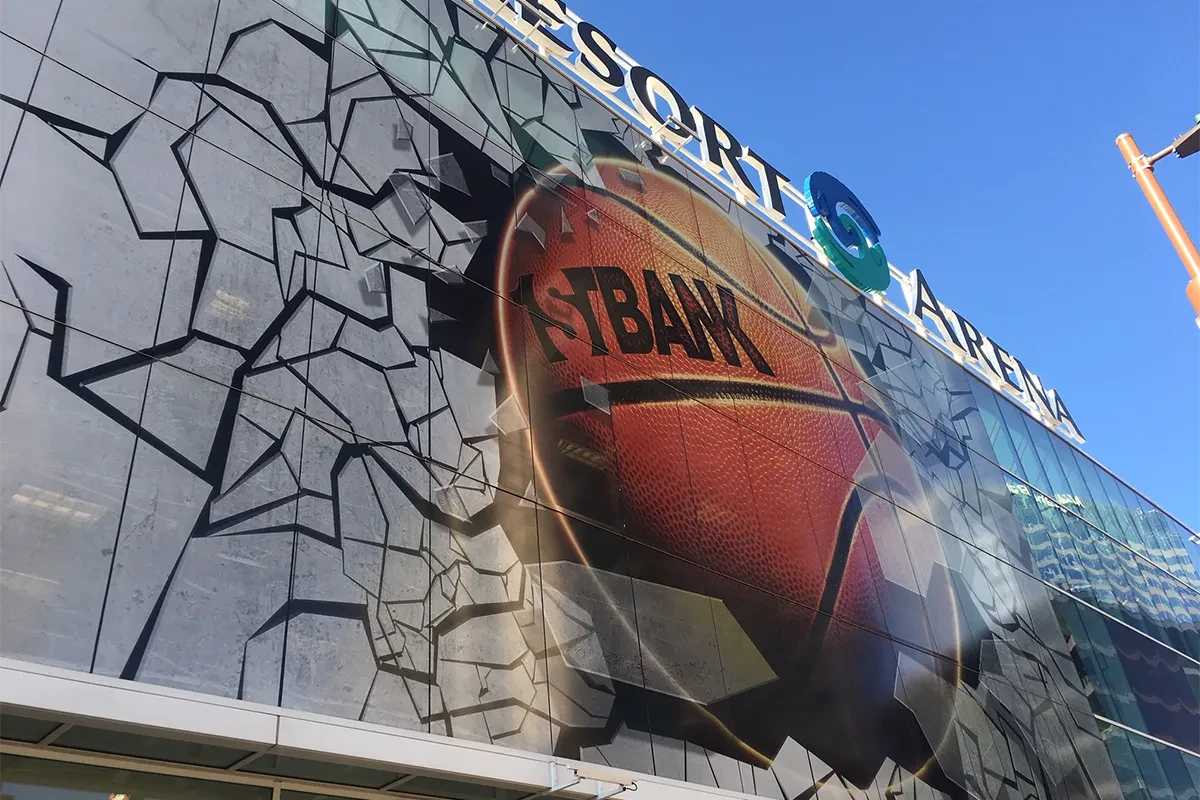
A building wrap does not behave like a standard sign. It does two jobs at once. From a distance, it creates territorial dominance. At street level, it becomes an orientation device: a landmark people use to navigate, meet, and film around.
There is also a psychological effect that marketers understand even when they rarely describe it clearly. Poster House’s 2025 exhibition on Nike’s sports-poster history put it bluntly: star athletes in these campaigns become “larger than life.” That phrase is not just aesthetic. It explains why a façade-sized image can outperform smaller repeated ads in a sports context. Sport already runs on hero imagery, tribal loyalty, and public ritual. Large-format wraps turn those abstractions into physical presence.
Adidas understood this years ago when it unveiled a Harlem wallscape tied to Muhammad Ali and New York youth-sports messaging. DraftKings used a related logic in New Jersey transit stations after sports betting legalization, where localized OOH messaging helped produce a reported 51% lift in app registrations. Different category, same principle: put the message where the fan is already moving, and make it feel native to the place.
The social spillover is no longer optional
The old billboard model was impression first, conversation second. That hierarchy has collapsed. A modern sports-related building wrap is designed to be seen twice: once in person, once in the feed.
OAAA’s research shows the link directly. In urban markets of one million or more, 61% of respondents said they had taken social-media-related actions after seeing OOH ads, and 52% agreed that adding social media elements made them more likely to engage with the brand online. Separate OAAA data found that iconic-location OOH and social-media integration increase influence, especially among younger and urban audiences.
That changes creative decisions. A sports wrap near a venue is no longer only a visibility asset. It is also a user-generated-content backdrop. The right wall does not just face traffic. It faces cameras. The right design is not just legible from a car. It reads in vertical video, survives cropping, and still signals the brand when fans post it without context. That is why brands keep pairing building wrap advertising with hashtags, athlete imagery, event timing, limited drops, and nearby retail conversion points. The wrap becomes the physical anchor; the phone finishes the distribution.
Building Wrap Ads Sport in NYC: What the rules actually allow
This is where many campaigns get sloppy. In New York, execution is not only creative. It is legal and structural.
Start with the basics. NYC requires a Department of Buildings sign permit for sign displays and installations under Construction Code §28-105.1. Signs smaller than six square feet and not illuminated are exempt, but most meaningful exterior commercial signage is not. If the sign is attached to a separate structure rather than placed directly on a wall or façade, additional alteration permitting may be required. Electrical work for illuminated signage requires a separate electrical permit.
Then comes zoning. In commercial districts, permitted sign area, projection, and height vary by district. For many commercial districts, sign surface area is tied to street frontage, with caps that can reach 500 square feet in higher-intensity districts; projection limits and height limits also apply, and roof signs are broadly prohibited in many districts. In other words: a contractor quoting quickly without checking zoning is not moving fast. He is setting up rework.
Historic districts add another review layer. The Landmarks Preservation Commission requires a completed application with photos and plans, and says a complete application can often be issued on initial review. Its signage guidebook also makes clear that size, location, and zoning all matter. That is one reason a storefront on a landmarked corridor cannot be treated like a blank media wall.
One more point matters for sports-style street domination in New York: sidewalk sheds are not a free-for-all. NYC states plainly that it is illegal to post business or advertising messages on a sidewalk shed, except where a lawful existing sign is obscured and a temporary replacement sign is allowed. If a structure projects on, under, or over a city street or sidewalk, revocable consent may also be required from DOT. Outdoor advertising companies operating without active DOB registration face fines of up to $25,000 per day.
That is the line serious buyers need to understand. In New York, “large” is not the same as “legal.” A competent building wrap contractor starts with zoning, structure, right-of-way exposure, landmark status, and permit pathway. Only then does design matter.
What a commercial building wrap actually costs
There is no official city rate card for wraps. Costs are market-driven and highly variable, so the numbers below should be treated as market estimates, not municipal pricing.
For production and installation alone, Britten gives a ballpark of roughly $2 to $5 per square foot. For media placement, AdQuick says wallscape campaigns in top-tier metros such as New York and Los Angeles can run $15,000 to $150,000+ per month, with production, installation, and permitting adding $5,000 to $25,000 depending on complexity. BM Outdoor’s New York wallscape page lists standard wallscapes starting around $25,000 per month and premium placements from $30,000 per month, with a stated 7–10 business-day install after production readiness. Those are vendor claims, not city benchmarks, but they are directionally useful for budgeting.
Timeline works the same way. There is no universal NYC clock, but field estimates from sign vendors commonly land around 2 to 4 weeks for standard sign-permit workflows once design documents are ready, while another industry source says building-wrap design and printing can take one to three weeks, with installation lasting anywhere from a day for small wraps to several days for large or high-rise projects. Again: market estimates, not guaranteed review times.
For a local buyer searching commercial building wrap near me or building wrap near me, the practical budget question is not “What does a wrap cost?” It is “Which cost bucket am I in?” In New York, there are really three:
- On-premise retail wrap or window-graphics program tied to your own frontage.
- Temporary promotional wrap linked to an event, launch, or fan wave.
- Off-premise wallscape/media buy where the façade itself is rented as advertising inventory.
Each has different legal exposure, production complexity, and media economics.
Where the sports playbook meets retail reality
Here is what actually happens in the field. A sportswear brand, sportsbook, or event promoter rarely relies on a single giant wrap. The more effective play is layered: one dominant visual anchor, repeated directional cues, and a nearby place to transact.
DraftKings’ Wrigley Field sportsbook project is a good example of what that integration mindset looks like in a venue environment. The installation centered on a 2,000-square-foot curved LED display designed to create an immersive betting and viewing space while navigating landmark-style approval constraints. The lesson for New York is not “build a sportsbook.” It is that physical media, place, and transaction perform better when treated as one system.
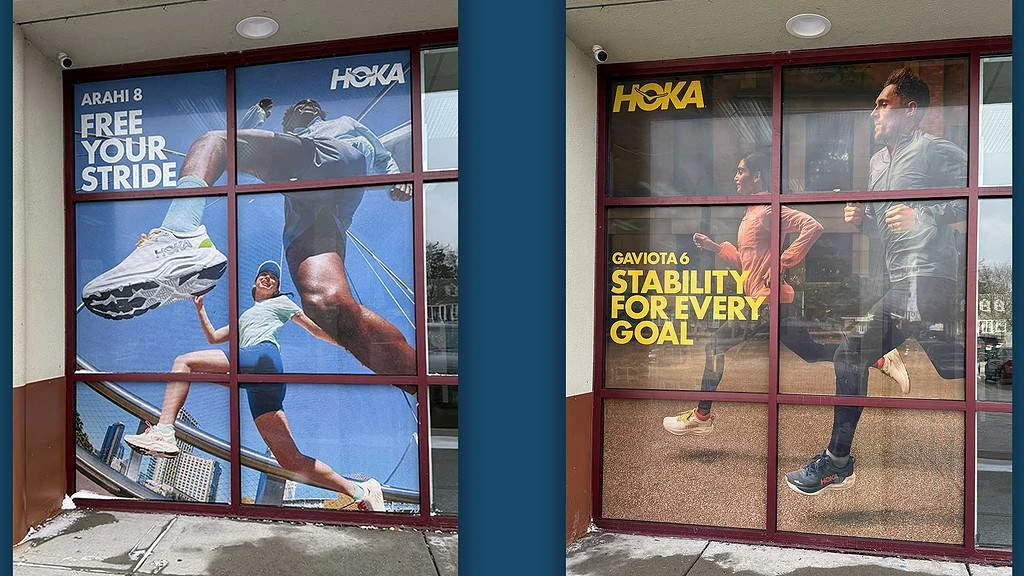
For a smaller NYC business, the retail version is simpler. Put the wrap where fan traffic emerges. Match it to storefront windows, decals, menu boards, or promotional displays. Tie the creative to a limited offer, event date, or team moment. Then make sure the store is close enough to convert the attention before it dissipates. That is the part many owners miss. Visibility without a cash register nearby is awareness. Visibility with a storefront nearby can become sales.
A restaurant near Barclays, for example, does not need a stadium-scale media budget. It may need a short-run exterior wrap, strong storefront window graphics, and a contractor who can align production, permit review, and installation without shutting down operations. That is where a local sign installation company either proves itself or becomes another source of delay.
How to choose a New York contractor without getting burned
A business owner does not need a lecture here. They need a filter.
Judge any building wrap company or building wrap contractor in New York on six points:
1. Permit literacy.
They should be able to explain DOB sign permits, electrical permits, zoning constraints, landmark review, and when DOT or revocable-consent issues enter the job. If they cannot explain the pathway, they are not ready for the project.
2. Structural realism.
They should ask about wall condition, mounting method, wind load, façade material, and access equipment before giving a serious number. NYC DOB’s design-professional guidance makes clear that sign projects require code and zoning review, not guesswork.
3. Neighborhood logic.
They should talk about pedestrian flow, transit exits, camera angles, and retail adjacency, not just print specs. That is the difference between signage and territorial marketing.
4. Production control.
Ask who prints, who installs, who handles permit drawings, and who owns the schedule. Too many multi-vendor jobs fail in the handoff.
5. Removal and maintenance.
A wrap is not finished when it goes up. Ask about inspections, repair, cleaning, and takedown.
6. Proof of similar work.
Not generic banners. Not interior vinyl. Actual exterior, commercial, site-specific work.
That is also where Easy Way Install should be evaluated. Not on branding language. On operations: drawings, permits, installation sequencing, storefront disruption, and whether the company understands that a sports-style territorial campaign in New York is a compliance problem, a logistics problem, and only then a design problem.
The bottom line
Sports brands use building wrap commercial strategy because it solves a hard problem: how to control attention before the customer reaches the event, the store, or the decision point. In New York, that means owning the route around transit hubs, arena districts, and fan zones; using scale to create recall; designing for social reposting; and executing inside a permit regime that is much less forgiving than most advertisers expect.
For business owners, the lesson is not to imitate Nike’s budget. It is to borrow Nike’s discipline. Choose the right block. Use the right format. Treat commercial building wrap, building wrap installation, and storefront conversion as one system. And if you are hiring a New York installer, hire one that can survive DOB, zoning, landmarks, scheduling, and street-level reality without improvising halfway through the job. That is what separates real building wrap services from expensive vinyl with no operating plan.