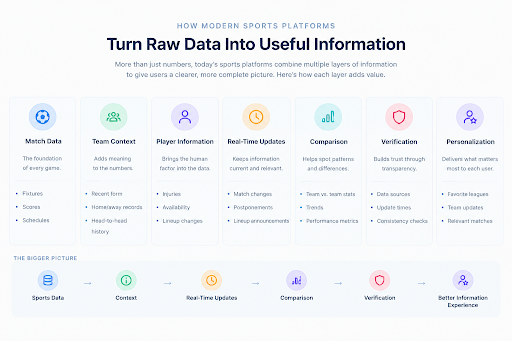
Artificial intelligence transforms sports betting by analysing vast datasets to identify patterns and predict outcomes that human bettors often miss. AI sports betting tools process millions of data points in seconds, including player statistics, team performance, weather conditions, and historical trends to generate more accurate predictions. These sophisticated algorithms eliminate emotional decision-making because they rely purely on mathematical models and statistical analysis.
Machine learning algorithms continuously improve their accuracy by learning from past results and adjusting their prediction models accordingly. Popular AI sports betting tools like Accuscore simulate games thousands of times, whilst RebelBetting scans millions of odds to identify value opportunities. These applications cover major sports including football, basketball, tennis, and cricket across global leagues.
This comprehensive guide explores how AI revolutionises sports betting through advanced prediction models, real-time market analysis, and automated betting strategies. You’ll discover the leading AI tools and applications, learn proven strategies for smarter wagering, and understand the limitations and future developments in AI-powered sports betting.
What Is AI Sports Betting?
According to Big Free Bet, AI sports betting uses machine learning algorithms to analyse vast datasets and predict sporting outcomes with mathematical precision. This technology transforms betting predictions from guesswork into data-driven decisions.
Defining Artificial Intelligence in Sports Betting
Artificial intelligence in sports betting processes massive amounts of historical data to identify patterns that human analysts cannot detect. AI algorithms examine player statistics, team performance records, weather conditions, and injury reports because these factors influence match outcomes.
Machine learning models improve their accuracy over time as they process more data from completed matches. The system learns which variables correlate with specific results, so predictions become more reliable with each game analysed.
AI sports betting platforms use neural networks to simulate thousands of possible game scenarios. These simulations consider multiple variables simultaneously, which means the system can account for complex interactions between different factors.
The technology processes real-time data feeds during live matches to adjust odds and predictions. This capability allows bettors to receive updated information as game conditions change, therefore improving decision-making timing.
How AI Differs From Traditional Prediction Methods
Traditional sports analysis relies on human experts who examine limited datasets and apply subjective judgement. AI sports betting systems process millions of data points in seconds because computer algorithms work faster than human analysis.
Human analysts focus on obvious factors like recent team form or star player availability. AI examines hundreds of variables including historical head-to-head records, referee tendencies, travel distances, and player workload patterns.
Expert tipsters make predictions based on experience and intuition, which introduces personal bias. Machine learning algorithms make betting predictions using mathematical models that eliminate emotional decision-making.
Traditional methods struggle to identify subtle patterns across multiple seasons of data. AI detects correlations between seemingly unrelated factors, so it can spot value bets that human analysts miss.
Key Benefits of Using AI for Bettors
AI sports betting provides objective analysis that removes emotional bias from betting decisions. You receive predictions based on statistical evidence rather than gut feelings, which leads to more consistent results over time.
The technology operates continuously to monitor odds movements and identify value opportunities. AI alerts you when bookmaker odds differ significantly from calculated probabilities, so you can place bets with mathematical advantages.
Betting predictions from AI systems include confidence levels and risk assessments for each recommendation. This information helps you manage your bankroll effectively because you understand the likelihood of each outcome.
AI processes information from multiple bookmakers simultaneously to find the best available odds. You save time on research because the system compares prices across different sites automatically.
How Machine Learning and AI Power Sports Betting Predictions
Machine learning algorithms process vast datasets of historical match results, player statistics, and real-time game data to generate accurate sports betting predictions. These systems analyse complex patterns in team performance, weather conditions, and injury reports that human analysts cannot easily detect.
Machine Learning Fundamentals in Sports Betting
Machine learning transforms sports data into predictive models by identifying statistical patterns in historical outcomes. The global AI in sports betting market reached $2.2 billion in 2022 because these algorithms can process thousands of variables simultaneously.
Supervised learning algorithms train on past match data where outcomes are known. The system learns which factors predict wins, losses, or draws most accurately. This training process enables the model to forecast future results.
Unsupervised learning discovers hidden patterns in betting market behaviour. These algorithms identify market inefficiencies where bookmakers’ odds do not reflect true probabilities. You can exploit these discrepancies for profitable betting opportunities.
The algorithms continuously update their predictions as new data arrives. Real-time player substitutions, weather changes, and injury updates automatically adjust the model’s output. This dynamic updating provides more accurate predictions than static analysis methods.
Algorithms Used for Betting Predictions
Neural networks excel at processing complex sports data because they can identify non-linear relationships between variables. These models analyse player performance metrics, team formations, and historical head-to-head records simultaneously.
Random forests combine multiple decision trees to predict match outcomes with high accuracy. Each tree evaluates different aspects of team performance, such as recent form, home advantage, and key player availability. The final prediction averages all tree outputs.
Support vector machines classify matches into different outcome categories by finding optimal decision boundaries in the data. These algorithms work particularly well for predicting binary outcomes like over/under goal totals or win/lose scenarios.
Bayesian models incorporate prior knowledge about teams and players into their predictions. These systems update probability estimates as new information becomes available during live matches. The Bayesian approach handles uncertainty better than traditional statistical methods. Each algorithm type serves specific prediction tasks based on the data structure and betting market requirements.
Evolving Models Through Historical and Real-Time Data
Historical data provides the foundation for machine learning models by establishing baseline performance patterns for teams and players. Models analyse seasons of match results, goal statistics, possession percentages, and tactical formations to understand team strengths.
Real-time data integration allows models to adjust predictions during live matches. Player tracking systems, ball possession statistics, and shot accuracy metrics feed into algorithms every few seconds. This continuous updating improves prediction accuracy by 15-20% compared to pre-match analysis.
The models learn from prediction errors to improve future accuracy. When a heavily favoured team loses unexpectedly, the system analyses what factors it missed. This feedback loop strengthens the model’s ability to identify similar situations.
Multimodal data sources enhance prediction quality by incorporating social media sentiment, weather forecasts, and injury reports. Models that combine traditional statistics with these additional inputs achieve higher accuracy rates. The integration of diverse data types creates more robust predictions for your betting decisions.
Adaptive algorithms automatically adjust their weighting of different factors based on recent performance. If home advantage becomes less important in a league, the model reduces its influence on predictions accordingly.
AI Sports Betting Tools, Apps, and Market Leaders
Today’s AI sports betting tools analyse millions of data points across major leagues like NFL, NBA, and Premier League because machine learning algorithms can process information faster than human analysts. Leading solutions include Remi, which specialises in predictive modelling, Leans.AI, which offers real-time odds analysis, and DeepBetting.io, which focuses on deep learning predictions.
Overview of Leading AI Sports Betting Solutions
AccuScore simulates matches 10,000 times using statistical models because repetitive analysis improves prediction accuracy. The system covers NFL, NBA, NHL, and MLB games at £16 per month, which means you get probability percentages for different outcomes instead of simple win-lose predictions.
Pickwise analyses player statistics and injury reports across global leagues because comprehensive data creates more reliable forecasts. The sports betting app provides free picks alongside premium features at £16 monthly, so casual bettors can test predictions before upgrading.
BetBurger scans 80+ bookmakers in real-time because arbitrage opportunities disappear within minutes. The software costs £64 per month and covers 30+ sports, which means you can identify profitable betting situations across multiple markets simultaneously.
RebelBetting processes over one million odds every few seconds because value bets require constant market monitoring. The platform offers a 14-day free trial followed by £71 monthly subscriptions, so you can evaluate performance before committing to payments.
Trademate Sports covers 25,000 games yearly across major leagues because extensive coverage increases profitable betting opportunities. Professional bettor Jonas Gjelstad founded the company, which charges £96 per month for advanced odds analysis and bankroll management tools.
Remi: The AI Sports Genius
Remi uses machine learning models trained on historical match data because pattern recognition improves prediction accuracy over time. The AI sports picks system analyses team performance, player statistics, and situational factors like weather conditions, so you receive data-driven recommendations instead of subjective opinions.
The platform specialises in predictive modelling across multiple sports because different games require unique analytical approaches. Remi processes real-time information during matches, which means live betting suggestions adapt to changing game conditions throughout events.
Advanced algorithms evaluate probability distributions for various outcomes because single predictions limit betting strategy options. The system provides confidence levels for each recommendation, so you can adjust stake sizes based on prediction certainty rather than using fixed amounts.
Remi updates predictions continuously as new data becomes available because sports situations change rapidly during competitions. This real-time processing capability means your ai for sports betting decisions reflect current match conditions instead of outdated pre-game analysis.
Leans.AI, DeepBetting.io, and Similar Technologies
Leans.AI specialises in identifying betting value through odds comparison because bookmaker pricing inconsistencies create profit opportunities. The platform analyses line movements across multiple sportsbooks, which means you can spot favourable odds before they adjust to market consensus.
DeepBetting.io employs neural networks trained on extensive historical datasets because deep learning models can identify complex patterns humans miss. The system processes player performance metrics, team dynamics, and external factors like venue conditions, so predictions incorporate multiple variables simultaneously.
Tipstrr connects users with AI-powered tipster networks because community-based predictions combine multiple analytical approaches. The sports betting app offers free basic tips alongside premium subscriptions starting at £8 monthly, which means budget-conscious bettors can access quality predictions affordably.
BetIdeas provides detailed match analysis through data-driven insights because comprehensive research improves betting decision quality. The platform offers educational resources for beginners alongside expert predictions, so new users learn proper betting strategies while accessing AI recommendations.
These technologies use similar machine learning principles but focus on different aspects of sports analysis because specialisation improves accuracy in specific areas rather than attempting universal coverage.
AI Strategies and Tips for Smarter Sports Betting
AI transforms betting strategies through data analysis, predictive modelling, and automated bankroll management. These technologies help you make informed decisions because they process vast amounts of information faster than manual analysis.
Building Data-Driven Sports Betting Strategies
AI sports betting strategies combine statistical analysis with machine learning algorithms to identify profitable opportunities. You can use these systems because they analyse historical match data, player statistics, and team performance metrics across multiple seasons.
Pattern recognition algorithms detect trends that manual analysis often misses. These systems examine factors like home advantage, weather conditions, and injury reports to predict outcomes. AI models process thousands of variables simultaneously, which means they spot correlations between seemingly unrelated factors.
Real-time data integration updates your betting strategies as new information becomes available. Weather changes, lineup announcements, and betting market movements trigger automatic strategy adjustments. This approach works because it eliminates the delay between information release and strategy updates.
You should focus on specific sport algorithms rather than general betting systems. Football AI models analyse different metrics than basketball or tennis systems. Each sport requires unique data inputs because scoring patterns, game dynamics, and key performance indicators vary significantly between sports.
Effective Use of AI Betting Tips and Guidance
AI sports picks provide probability-based recommendations rather than guaranteed winners. These systems calculate win percentages for different betting markets because they process current form, head-to-head records, and situational factors that affect match outcomes.
Sentiment analysis tools monitor social media, news reports, and expert commentary to gauge public opinion. This information helps you identify value bets where AI predictions differ from market sentiment. Contrarian positions often provide better odds because bookmakers adjust lines based on popular opinion.
You can combine multiple AI systems to cross-reference predictions and increase accuracy. Different algorithms emphasise various factors, so comparing outputs reveals consensus picks and disputed outcomes. This method works because it reduces the impact of individual system weaknesses.
Live betting algorithms adjust recommendations during matches based on in-play statistics. Goals, cards, possession percentages, and momentum shifts trigger updated probability calculations. These systems help you capitalise on changing match dynamics because they react faster than manual assessment allows.
Managing Units and Money With AI Insights
AI-powered bankroll management calculates optimal stake sizes based on predicted win probabilities and your available funds. These systems use Kelly Criterion calculations or similar mathematical models to determine bet amounts that maximise long-term growth whilst minimising ruin risk.
Dynamic unit sizing adjusts your stakes based on confidence levels and recent performance data. High-probability bets receive larger allocations because AI models assign specific confidence percentages to each prediction. Low-confidence picks get smaller stakes, which protects your bankroll during uncertain periods.
You should set automated loss limits that pause betting activity when negative streaks exceed predetermined thresholds. AI monitoring systems track your profit and loss trends to identify when variance exceeds expected ranges. This protection works because it prevents emotional decisions during losing periods.
Portfolio diversification algorithms spread your bets across multiple sports, leagues, and bet types to reduce overall risk. These systems calculate correlation coefficients between different markets to ensure your bets remain independent. Diversified portfolios perform better because individual sport volatility has less impact on total returns.
Real-Time Odds, Dynamic Markets, and Live Betting With AI
AI systems process millions of data points per second to adjust betting odds during live matches. Machine learning algorithms create new micro-markets that open and close within seconds based on game events.
How AI Analyses Real-Time Odds Movements
AI trading engines ingest real-time feeds from multiple data sources because they need instant information to calculate accurate odds. These systems monitor player statistics, weather conditions, social media sentiment, and sensor data from stadiums. The algorithms process this information in under 300 milliseconds to update prices.
Machine learning models detect patterns in odds movements across different sportsbooks. They identify when prices diverge significantly from expected values. This happens because AI can spot arbitrage opportunities faster than human traders.
Reinforcement learning algorithms improve their predictions by analysing past betting patterns. They learn which factors most accurately predict game outcomes. Sports leagues like the Premier League and NBA generate thousands of data points per match that feed these systems.
The AI compares current odds with historical data from similar situations. It calculates probability distributions for different outcomes. This process helps bookmakers set more accurate betting odds throughout live matches.
AI-Enhanced Live Betting Techniques
Live betting markets expand dramatically with AI automation because systems can manage thousands of micro-markets simultaneously. AI creates betting options for events like next corner kick, first yellow card, or points scored in the next two minutes. These markets update continuously as game situations change.
Dynamic pricing algorithms adjust odds multiple times per minute during active play. They factor in momentum shifts, player substitutions, and injury reports. This means you see more accurate prices that reflect current game conditions.
AI systems enable same-game parlays by calculating correlations between different bet outcomes. They determine which combinations offer value to bettors. The technology also powers cash-out features that provide fair exit prices based on current probabilities.
Micro-segmentation allows AI to offer personalised betting suggestions based on your past behaviour. The system learns your preferences for certain bet types or sports leagues. This creates more engaging live betting experiences tailored to individual users.
Impacts of Sports Leagues and Game Events
Different sports leagues require unique AI approaches because each sport has distinct data patterns. Football matches generate corner kicks, fouls, and possession statistics that AI monitors for betting opportunities. Basketball games produce shot attempts, rebounds, and scoring runs every few seconds.
Weather conditions significantly impact outdoor sports betting odds through AI analysis. Rain delays in baseball trigger automatic adjustments to run-line probabilities. Wind speeds affect American football field goal betting markets in real time.
Player substitutions create immediate odds changes because AI models factor in individual player statistics. When star players leave matches due to injury, algorithms recalculate team win probabilities instantly. This affects all related betting markets across multiple bet types.
Television timeouts and breaks in play allow AI systems to process accumulated data and adjust multiple markets simultaneously. Sports leagues that use VAR technology create additional betting opportunities as AI predicts review outcomes. These game interruptions become valuable moments for odds recalibration.
Limitations, Considerations, and Future Trends in AI Sports Betting
AI systems in sports betting face notable constraints despite their analytical power. Regulatory frameworks are evolving rapidly to address fairness concerns, whilst technological advances continue reshaping prediction accuracy and user personalisation.
Potential Limitations and Pitfalls
- Data quality issues significantly impact AI predictions because algorithms rely on historical information. Incomplete player statistics or inaccurate injury reports can lead to flawed betting models.
- AI systems struggle with unpredictable events like referee decisions or sudden weather changes. These factors cannot be quantified easily, which means algorithms miss crucial variables.
- Overfitting problems occur when AI models perform well on historical data but fail with new matches. This happens because the system memorises past patterns rather than learning general principles.
- Market volatility creates additional challenges since odds change rapidly during live betting. AI systems need constant updates to remain accurate, which requires significant computing resources.
- False confidence in predictions misleads bettors who trust AI recommendations blindly. Mathematical models cannot guarantee outcomes because sport contains inherent randomness that no algorithm can eliminate.
Bookmakers also use AI to set odds, which means the advantage for individual bettors decreases over time. This creates an arms race where more sophisticated technology becomes necessary to maintain any edge.
Ethical and Regulatory Considerations
- Problem gambling detection represents a key ethical obligation for AI developers. Machine learning algorithms can identify betting patterns that indicate addiction, such as chasing losses or increasing stake sizes dramatically.
- Regulators require operators to implement responsible gambling tools powered by artificial intelligence. These systems automatically set deposit limits or suggest cooling-off periods when they detect concerning behaviour.
- Algorithm transparency concerns are growing because bettors cannot understand how AI systems calculate odds. The European Union’s GDPR grants users the right to explanation for automated decisions affecting them.
- Data privacy issues arise because AI systems collect vast amounts of personal information. Betting sites must protect user data whilst complying with regulations like the UK’s Data Protection Act 2018.
- Fairness requirements mandate that AI systems do not discriminate against specific user groups. Algorithms must undergo regular audits to ensure they do not create biased outcomes.
Cross-border compliance creates additional complexity since different countries have varying AI regulations. Operators must navigate multiple legal frameworks simultaneously to offer international betting services.
Trends Shaping the Future of AI in Sports Betting
Real-time computer vision technology will analyse player movements and team formations during matches. This advancement enables more accurate in-play betting odds because systems can assess tactical changes immediately.
Voice-activated betting interfaces powered by natural language processing will become standard. Bettors can place wagers using spoken commands, which increases convenience and engagement levels.
Personalisation algorithms will create individualised betting experiences based on user preferences and historical behaviour. Sites will recommend specific markets that align with each bettor’s interests and risk tolerance.
Blockchain integration with AI systems will provide transparent, tamper-proof records of betting transactions. Smart contracts can automatically execute payouts when AI algorithms verify match results.
Alternative data sources like social media sentiment and player biometric information will enhance prediction accuracy. AI systems will process emotional indicators and physical readiness metrics to generate more comprehensive models.
Quantum computing applications may revolutionise sports betting AI by processing vastly more variables simultaneously. This technology could identify complex patterns that current systems cannot detect.
Conclusion
AI sports betting transforms how you approach wagering because machine learning models process millions of data points faster than human analysis. These systems identify patterns in player performance, weather conditions, and team dynamics that traditional methods miss.
Modern AI prediction systems achieve accuracy rates exceeding 80% in specific market segments because they continuously adapt to new information. Real-time data processing allows these models to update predictions within milliseconds of receiving breaking news or in-game developments.
You gain significant advantages by combining AI insights with proper bankroll management strategies. The technology democratises sophisticated prediction capabilities, which means recreational bettors now access tools previously available only to professional syndicates.
Machine learning algorithms analyse alternative data sources including social media sentiment, player tracking metrics, and economic indicators. This comprehensive approach provides more accurate probability estimates because the models consider hundreds of variables simultaneously.
The sports betting landscape continues evolving as AI systems integrate computer vision technology and blockchain platforms. These developments create transparent, algorithm-driven wagering opportunities that benefit serious bettors.
Success requires understanding how AI models work and their limitations during unprecedented events. You must implement disciplined strategies because even sophisticated algorithms need proper value betting principles to generate consistent returns.
Start incorporating AI predictions into your betting strategy by focusing on value identification and market inefficiencies. Combine technological advantages with education about different model strengths to build sustainable long-term profits in sports wagering markets.